The Matthias Rippmann Memorial Prize 2023
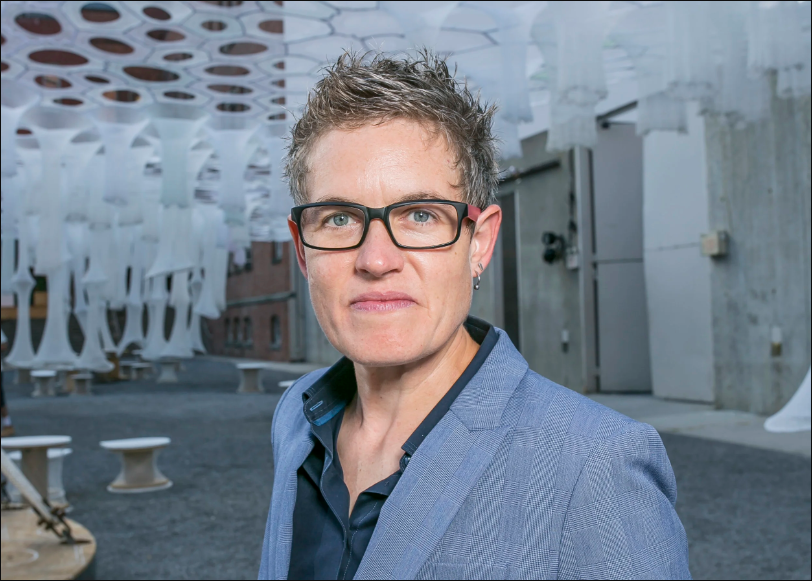
Jenny Sabin
Jenny E. Sabin is an architectural designer whose work is at
the forefront of a new direction for 21st century architectural practice — one
that investigates the intersections of architecture and science and applies insights
and theories from biology and mathematics to the design of responsive material
structures and ecological spatial interventions for diverse audiences. Sabin is the
Arthur L. and Isabel B. Wiesenberger Professor in Architecture and the inaugural
Chair for the new multicollege Department of Design Tech at the Cornell College of
Architecture, Art, and Planning where she established a new advanced research degree
in Matter Design Computation. She is principal of Jenny Sabin Studio, an
experimental architectural design studio based in Ithaca and Director of the Sabin
Design Lab at Cornell AAP. Her book, LabStudio: Design Research Between Architecture
and Biology, co-authored with Peter Lloyd Jones was published in July 2017. In that
same year, Sabin won MoMA & MoMA PS1’s Young Architects Program with her
submission, Lumen.
The Matthias Rippmann Memorial Prize 2022
Daniel Piker
Fosters and Partners, Kangaroo, and McNeil.
The Matthias Rippmann Memorial Prize 2021
Sigrid
Adriaenssens
Dr. Adriaenssens’s research focuses on lightweight
surface systems and how they can be optimized and realised to interact with extreme
structural or environmental loading. This includes research on flexible and rigid
shells and plates, submerged flexible membranes and nets, and metamaterials with
applications for a resilient urban environment. The applications range from adaptive
building shading devices to large-scale inflatable storm surge barriers and are
sometimes inspired by systems that evolved in biology, art or architecture.
Dr.Adriaenssens’ research spans analytical approaches to study non-linear
mechanics, seeking new numerical form finding, optimization and machine-learning
approaches and fluid-interaction models as well as experimental aspects based on
prototyping of small and medium scale systems using CAD/CAM and robotic
construction.
The Matthias Rippmann Memorial Prize 2020
Matthias
Rippman (RhinoVAULT2)
A brief introduction on Dr. Matthias Rippman’s
contributions, visions and achievements on RhinoVAULT 2
The Rhinoceros® plug-in RhinoVAULT, developed by Dr.
Matthias Rippmann at the Block Research Group (BRG) of ETH Zurich, emerged from
research on structural form finding using Thrust Network Analysis (TNA) and was
developed to facilitate the creation and exploration of compression-only, funicular
structures.
RhinoVAULT provides an intuitive method for funicular form
finding, adopting the same advantages of techniques such as graphic statics, but
offering a viable extension to fully three-dimensional problems. The designer can
control the many degrees of freedom of highly indeterminate three-dimensional
equilibrium systems to explore structural form. Since its release in 2014,
RhinoVAULT has been downloaded by more than 30’000 designers, and it has been
used to design surprising free-form funicular shells all over the world.
Because of the tragic passing of Dr. Rippmann, development of
RV has stopped. In order to provide continued form-finding exploration and fun, the
BRG has developed the brand-new open-source framework, RhinoVAULT 2 (RV2), based on
COMPAS.
The Block Research Group (BRG) at the Institute of Technology
in Architecture at ETH Zürich is led by Prof. Dr. Philippe Block and Dr. Tom
Van Mele. Research at the BRG focuses on several core areas, including analysis of
masonry structures, graphical analysis and design methods, computational form
finding and structural design, discrete element assemblies, and fabrication and
construction technologies. The central goals of our geometry-based approach are to
understand the real demands of complex structural design and engineering problems
and to develop new algorithms and efficient, accessible tools for structurally
informed design.







 loading......