DigitalFUTURES Project Award 2024

TEIXIT
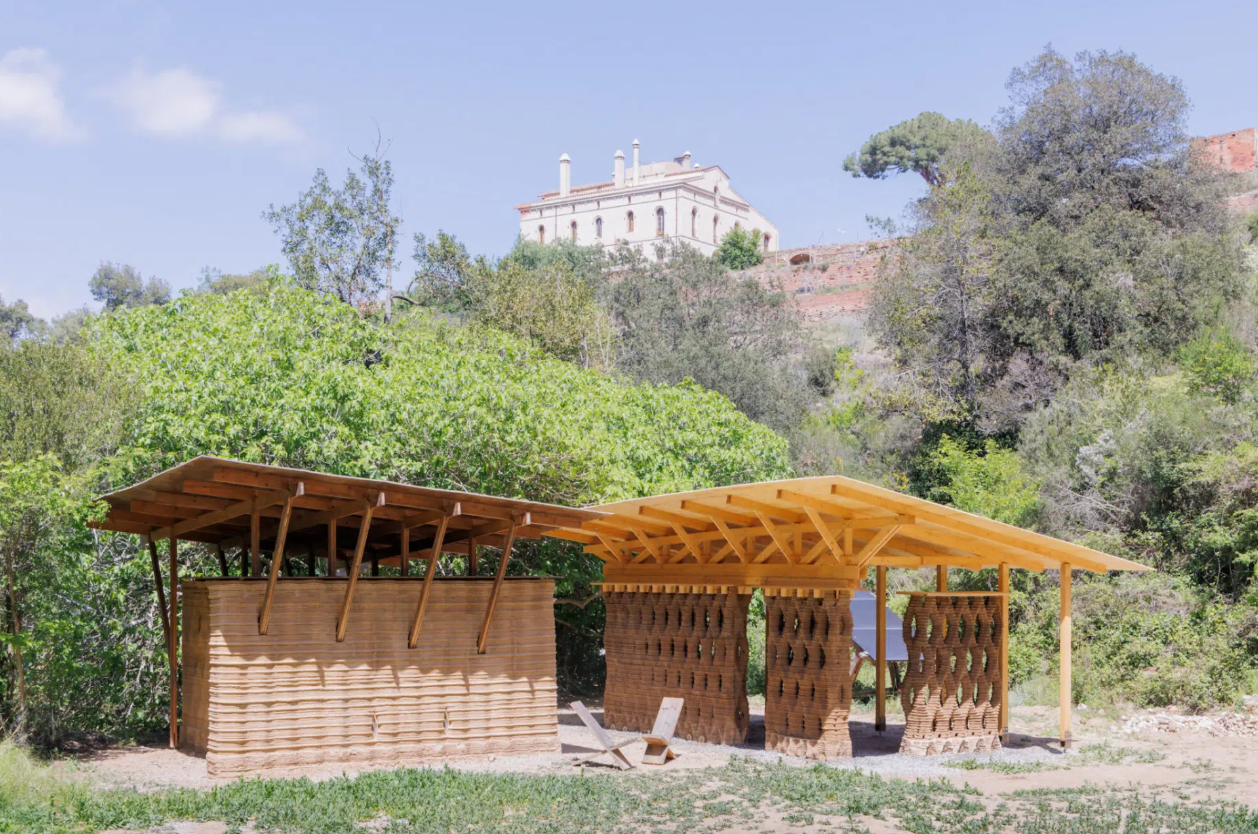
The students and researchers of the Postgraduate Programme in 3D Printing Architecture (3DPA) have expanded the 3D-Printed Earth Forest Campus by building Teixit, an innovative structure 3D printed from local earth. Utilizing computational design and robotic technology, this unique structure demonstrates that earth walls can be both structural and perforated, offering new opportunities for sustainable architecture. Teixit complete a 100 m² low carbon emissions building prototype, using local soil, natural materials and the pioneering Crane WASP 3D printer. Adjacent to TOVA, 3DPA’s previous prototype constructed in 2022, Teixit extends the living and working area of the forest robotic campus in the Collserola Natural Park.
Project credits
Directors
Edouard Cabay
Alexandre Dubor
Coordinator
Yara Tayoun
Faculty
Oriol Carrasco, Senior Fabrication Expert
Elisabetta Carnevale, Material Expert
Alicia Huguet, Structural Expert – SOCOTEC Spain
Faculty Assistants
Secil Afsar, Fabrication Assistant, Material Research Expert
Nestor Beguin, Computational Expert
Collaborators
Colette, philanthropic organisation
3D WASP, Large Scale 3D printing
SOCOTEC, Structural Consultant
Hassell Studio, Architecture Consultant
Vervictech, Enzymes provider
Researchers
Jose Antonio Gutierrez Rangel, Joseph Milad Wadie Naguib, Justin Hanlon, M´Hamed Alila, Maria Kaltsa, Mark Francis, Noel Akroma, Sakshi Pawar, Sara Ayoub, Vesela Tabakova, Yang Xiao
Special thanks
Areti Markopoulou, Mathilde Marengo, Daniel Ibanez, Ricardo Mayor, Shyam Zonca, Sheikh Riaz, Philip Wienkamper, Pilar Xiquez, Daniela Figueroa Claros, Jorge Ramirez, Massimo Visiona, Massimo Moretti, Francesca Moretti, Laia Pifarre, Bruno Ganem, Xavier de Kestelier

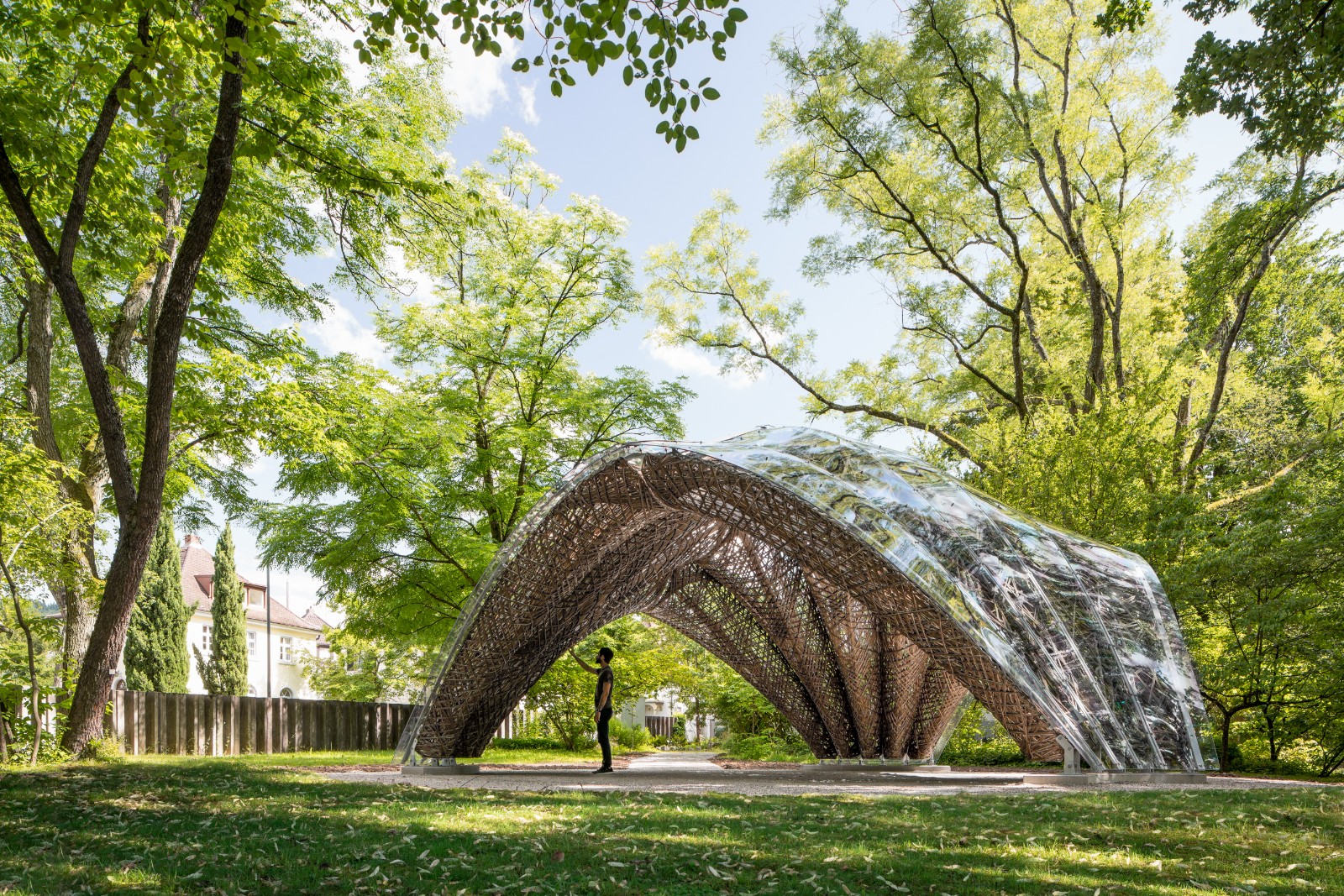
The livMatS Pavilion offers a viable, resource-efficient alternative to conventional construction methods and therefore represents an important step towards sustainability in architecture. It constitutes the first building ever with a load-bearing structure that is entirely made of robotically wound flax fibre, a material that is fully renewable, biodegradable, and regionally available in Central Europe. Through a novel combination of natural materials and advanced digital technologies, this pavilion stems from the successful collaboration of an interdisciplinary team of architects and engineers of the ITECH master`s programme at the Cluster of Excellence IntCDC at the University of Stuttgart and biologists from the Cluster of Excellence livMatS at the University of Freiburg. The bioinspired pavilion showcases how novel co-design processes that account concurrently for geometrical, material, structural, productional, environmental, and aesthetic requirements, together with advanced robotic fabrication techniques applied to natural materials, are capable to generate both expressive and ecological architecture.
PROJECT TEAM :
livMatS Pavilion, Botanic Garden of the University of Freiburg
ICD Institute for Computational Design and Construction - Prof. Achim Menges
Cluster of Excellence IntCDC, University of Stuttgart
ITKE - Institute of Building Structures and Structural Design - Prof. Jan Knippers
Cluster of Excellence IntCDC, University of Stuttgart
Scientific Development:
Marta Gil Pérez, Serban Bodea, Niccolò Dambrosio, Bas Rongen, Christoph Zechmeister
Project Management:
Katja Rinderspacher, Marta Gil Pérez, Monika Göbel
Concept Development, System Development, Prototyping:
2018-2020: Talal Ammouri, Vanessa Costalonga Martins, Sacha Joseph Cutajar, Edith Anahi Gonzalez San Martin, Yanan Guo, James Hayward, Silvana Herrera, Jeongwoo Jang, Nicolas Kubail Kalousdian, Simon Jacob Lut, Eda Özdemir, Gabriel Rihaczek, Anke Kristina Schramm, Lasath Ryan Siriwardena, Vaia Tsiokou, Christo van der Hoven, Shu Chuan Yao
2018-2019: Karen Andrea Antorveza Paez, Okan Basnak, Guillaume Caussarieu, Zhetao Dong, Kurt Drachenberg, Roxana Firorella Guillen Hurtado, Ridvan Kahraman, Dilara Karademir, Laura Kiesewetter, Grzegorz Łochnicki, Francesco Milano, Yue Qi, Hooman Salyani, Nasim Sehat, Tim Stark, Zi Jie, Jake Tan, Irina Voineag
Facade Development: Tim Stark
With support of: Okan Basnak, Yanan Guo, Axel Körner Student assistance: Matthew Johnson, Daniel Locatelli, Francesca Maisto, Mahdieh Hadian Rasanani, Lorin Samija, Anand Shah, Lena Strobel, Max Zorn
FibR GmbH, Stuttgart
Moritz Dörstelmann, Ondrej Kyjanek, Philipp Essers, Philipp Gülke
with support of: Erik Zanetti, Elpiza Kolo, Prateek Bajpai, Hooman Salyani, Jamiel Abubaker, Julian Fial, Sergio Maggiulli, Mansour Ba, Christo van der Hoven A joint project of the Clusters of Excellence livMatS, University of Freiburg (Prof. Dr. Thomas Speck, Prof. Dr. Jürgen Rühe,) and IntCDC, University of Stuttgart
Supported by:
Deutsche Bundesstiftung Umwelt
Exolon Group GmbH

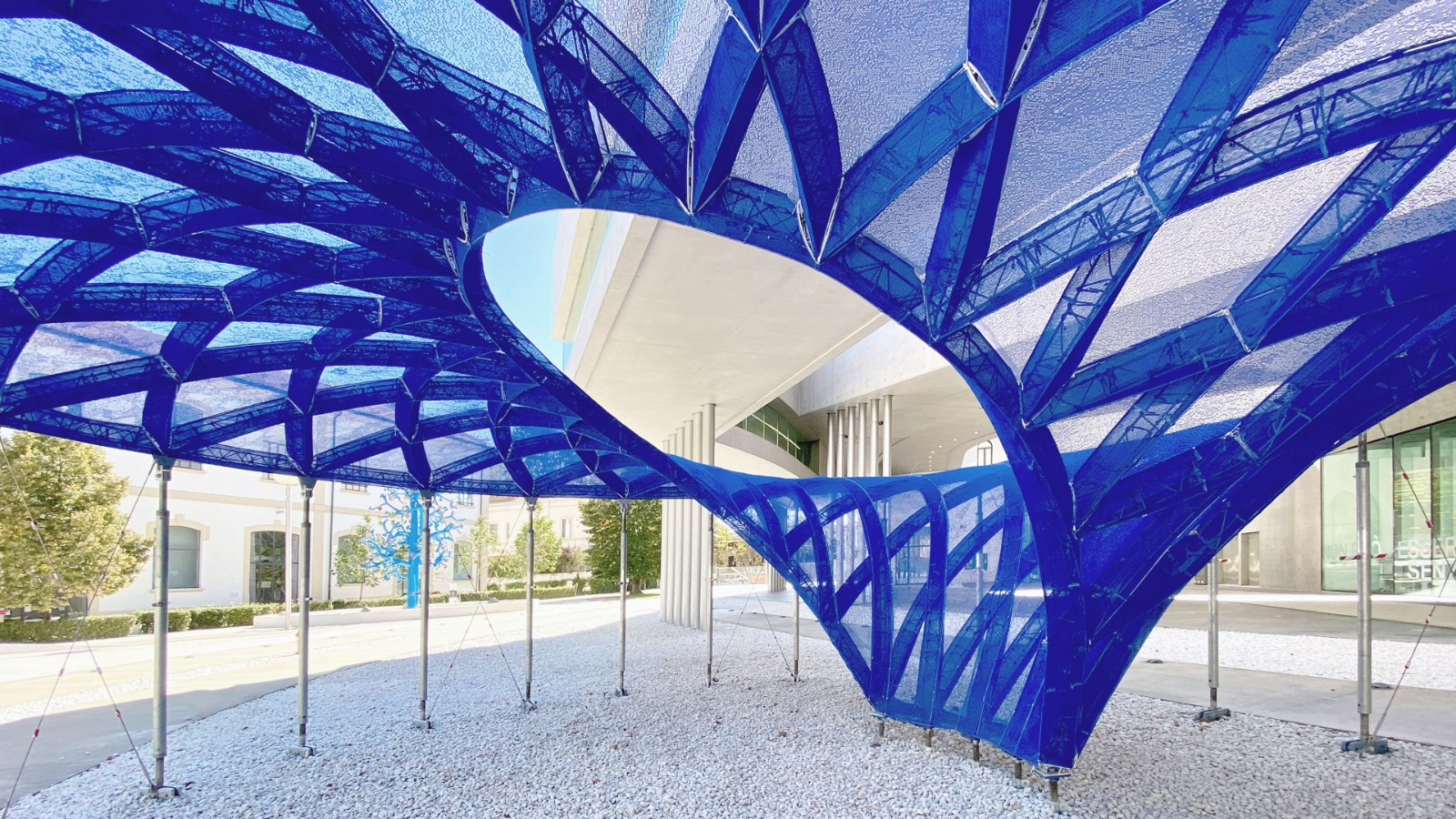
Knitnervi is a pavilion-scale demonstrator of a flexible formwork system for constructing a ribbed concrete shell. The highly articulated, doubly-curved geometry is form found to act in pure compression with a tension ring at its perimeter. A bending-active gridshell serves as the primary structure of the formwork and simultaneously as the integrated reinforcement of the final concrete shell. KnitCrete, a CNC-knitted flexible stay-in-place shuttering, encapsulates the expressive geometry.
KnitNervi draws inspiration from the pioneering Palazzetto dello Sport by Pier Luigi Nervi to reimaginea ribbed, thin-shell, reinforced-concrete construction. The project breaks away from the prefabrication and standardisation paradigms enabling expressive and efficient concrete shells by proposing a construction

loading......